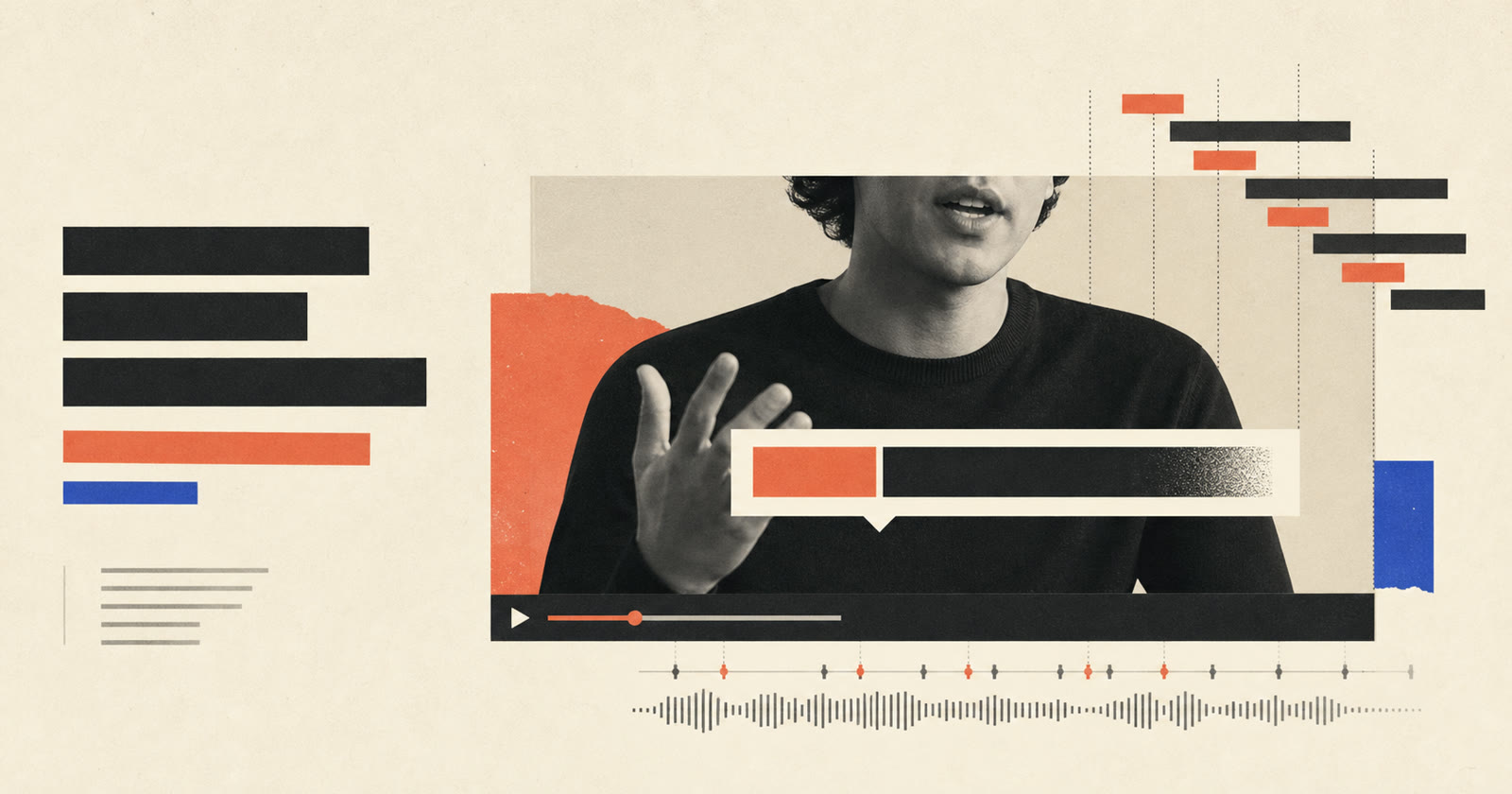
To remove pauses and filler words from video without creating robotic speech, use the transcript to find candidates, classify why each moment exists, then delete only the gaps and fillers that delay meaning. Preserve pauses that separate ideas, support emphasis or give the viewer time to understand.
Automatic detection is useful for finding work. It should not become an instruction to delete everything it finds.
The short answer
Use this decision rule:
Remove a pause or filler when it adds friction without adding meaning. Keep it when it carries thought, emotion, emphasis or necessary breathing room.
That rule is more reliable than one universal duration threshold. Different speakers, languages, subjects and platforms need different rhythms.
Four kinds of silence
Before deleting a gap, decide which kind it is.
Recording delay
The speaker has finished one usable thought but has not started the next. Long setup gaps, checking notes and waiting for a prompt often belong here. These are strong cleanup candidates.
Thinking pause
The speaker is choosing words. In a casual tutorial, shortening it may help. In an interview, the hesitation may communicate uncertainty or care and should remain.
Emphasis pause
The gap is placed before or after an important claim. Removing it can flatten the delivery and make the following sentence feel rushed.
Comprehension pause
The viewer needs time to read a number, inspect a screenshot or understand a diagram. The audio may be silent, but the video is still doing work.
Silence is not automatically empty. Judge what the whole frame communicates.
Filler words are not one category
Words such as "um", "uh", "like" and repeated conjunctions can serve different functions:
- A disposable hesitation between two complete phrases.
- A sound attached to the beginning of the next word.
- A conversational marker that belongs to the speaker's voice.
- A sign that the claim is uncertain.
- Part of a quotation or imitation.
Bulk deletion is safest only for clearly disposable instances. Adobe's current Text-Based Editing can filter and bulk-delete fillers and pauses, but its documentation presents those tools inside a broader editing workflow. Detection does not remove the need to hear each result.
A safe transcript-first workflow
Generate and correct the transcript
Correct the words that affect meaning before using transcript filters. Poor audio, accents and product terminology can create false matches. YouTube recommends manually reviewing automatic captions because machine transcription can misrepresent speech.
Search one class at a time
Review long pauses first, then repeated filler words, then shorter hesitations. Mixing every cleanup class into one bulk action makes it difficult to understand why the pacing changed.
Work in a copy or editable composition so rejected changes can be reversed.
Classify before deleting
Give each candidate one label:
- Remove.
- Shorten.
- Keep.
- Review with picture.
"Review with picture" is important when a pause overlaps a product demonstration, on-screen source or reaction.
Cut a small group, then listen
Do not process the whole recording before checking results. Apply a small group of similar decisions and listen through the surrounding paragraph.
Watch for a cumulative problem: every individual cut may sound acceptable, but many cuts together can remove all breathing room.
Restore natural boundaries
If a cut clips a consonant, breath or word ending, move its boundary. If adjacent sentences collide, restore some space. If background noise changes suddenly, choose a boundary with more consistent room tone.
The goal is not maximum density. The goal is a clear thought delivered at a believable pace.
How to review the result
Listen without picture
Audio-only review exposes clipped sounds, missing breath, unnatural acceleration and noise changes. If the dialogue sounds edited when you are not looking, visuals will not fix it.
Watch without sound
Silent review exposes head and hand jumps, caption timing problems and B-roll that no longer matches the sentence.
Read the final transcript
Check whether punctuation and paragraph breaks still represent the edited speech. Make sure captions do not contain words that were deleted from the audio.
Watch at normal speed
Do not rely only on faster review playback. A pace that feels fine at increased speed may feel crowded at normal speed, while meaningful pauses can disappear during skimming.
Pauses around numbers and graphics
Pause cleanup should be coordinated with visual explanation. If a speaker says a number and a metric card appears, the viewer needs time to connect the spoken value with the graphic.
Use this sequence:
- Verify the spoken number.
- Verify the on-screen number.
- Let the graphic enter close to the claim.
- Keep enough time for it to be read.
- Remove only the remaining dead space.
An automatic video editor can prepare transcript cuts, captions and visual blocks as one composition. Human review still decides whether the combined timing is understandable.
What can go wrong with aggressive cleanup
| Symptom | Likely cause | Better correction |
|---|---|---|
| Speech sounds breathless | Too many gaps removed | Restore space at idea boundaries |
| First sound is clipped | Cut starts inside a word | Move boundary before the full sound |
| Speaker looks nervous | Every hesitation was removed | Keep pauses that show considered thought |
| Jump cuts dominate | Audio cleanup ignored picture | Use fewer cuts or motivated visual coverage |
| Captions feel early | Text timing was not updated | Regenerate or retime after dialogue edits |
| Viewer misses a graphic | Comprehension pause was deleted | Restore time for reading |
Avoid hiding these problems under music. Music can change perceived energy, but it does not restore a missing consonant or make a crowded explanation easier to understand.
A repeatable review checklist
- Transcript matches the actual retained words.
- Names, numbers and technical terms are correct.
- No first consonant or final syllable is clipped.
- Important idea boundaries still have space.
- Fillers that express uncertainty remain when relevant.
- Background noise does not jump at cut points.
- Visual jumps are acceptable or intentionally covered.
- Captions were retimed after the final dialogue pass.
- Graphics remain visible long enough to understand.
- The speaker still sounds like the same person.
Frequently asked questions
Should I remove every "um" and "uh"?
No. Remove the ones that add friction without meaning. Keep an instance when cutting it damages a word, removes useful uncertainty or makes the delivery unnaturally dense.
How long does a pause need to be before removal?
There is no universal duration. A short gap can feel slow in a fast list, while a longer pause may be necessary after a complex claim. Judge the role of the pause and the surrounding pace.
Can software remove silence automatically?
Yes, software can detect gaps and create candidate cuts. The reliable workflow keeps the result editable and reviews audio, picture, captions and meaning before export.
Why do automatic cuts sometimes sound harsh?
The boundary may intersect a sound or breath, adjacent phrases may collide, or the background noise may change. Restore a natural boundary instead of adding a visual transition.
Should pause cleanup happen before captions?
Generate the transcript early, but finalize visible captions after dialogue cleanup. Otherwise every removed gap changes caption timing.
Start with one paragraph, not a full batch. Use the AI talking-head editor to prepare a reviewable pass, listen to every candidate cut, then use conversational revisions for the moments that need a different decision.